
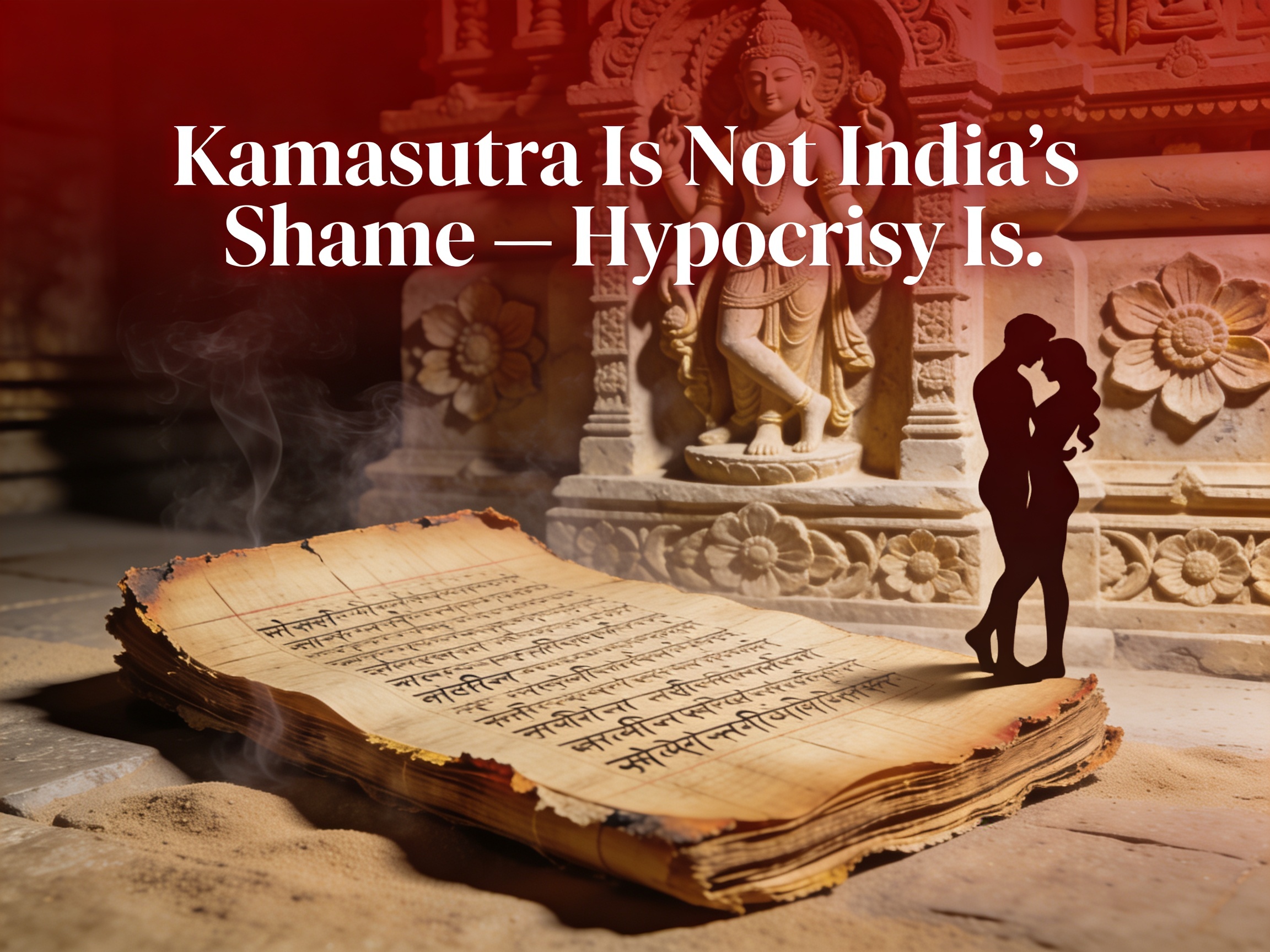
Kamasutra Is Not India’s Shame — The Truth About Hypocrisy
Kamasutra Is Not India’s Shame — Hypocrisy Is.
How colonial prudery, selective tradition, and fake holiness distorted one of India’s deepest conversations about desire
There is something profoundly revealing about the way modern India reacts to the Kamasutra.
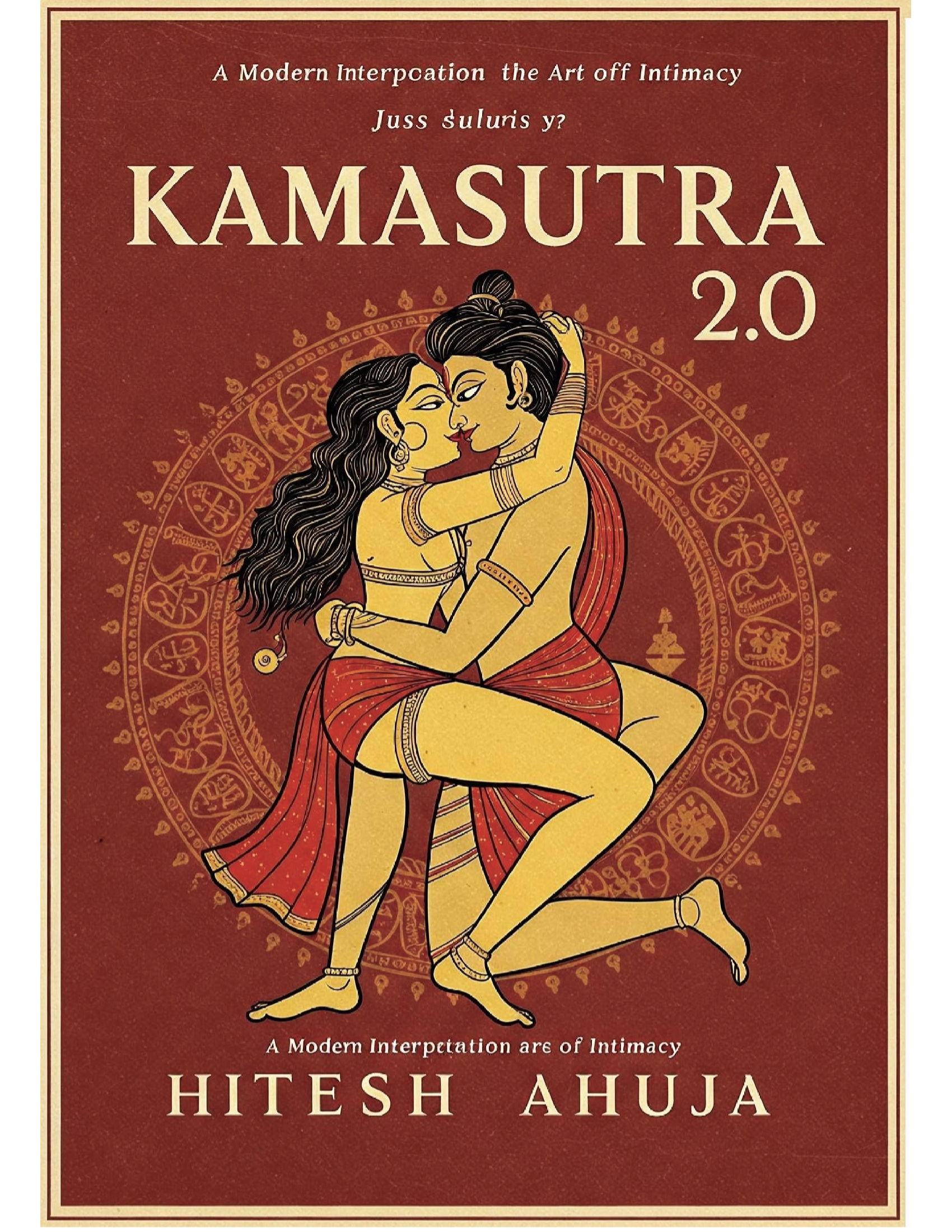
The civilization that produced one of the world’s most famous texts on desire, pleasure, intimacy, and refined living now often behaves as if that text were an embarrassing family scandal — something to be hidden, mocked, oversimplified, or blamed on moral decline. This reaction tells us less about the Kamasutra and more about the fragile state of contemporary cultural consciousness.
Because the truth is simple, sharp, and deeply uncomfortable:
Kamasutra is not India’s shame. It is India’s mirror.
And what embarrasses many people is not the text itself, but what it reveals about the poverty of our modern understanding.
The first misunderstanding must be cut away immediately. The Kamasutra is not merely a manual of sexual positions. That popular reduction is not scholarship; it is cultural laziness. Devdutt Pattanaik notes that only a fraction of the text deals directly with sexual technique. Much of it addresses the philosophy of pleasure, relational conduct, social refinement, aesthetics, courtship, and the broader place of kama in human life.
In other words, the text belongs to a more sophisticated civilizational framework than many modern commentators can bear. In classical Indian thought, kama was not simply lust. It referred to desire, longing, pleasure, attraction, and the energies that move life itself. It stood in relationship with dharma and artha— ethics, responsibility, material life, and social order. This does not mean every indulgence was celebrated. It means the human condition was taken seriously enough to be studied, not merely shamed.
This is where the crisis of modern moralism becomes obvious.
A society that cannot distinguish between intelligent discourse on desire and vulgar sensationalism has already surrendered depth for reaction. It has replaced wisdom with nervousness. It has turned discomfort into doctrine.
That is precisely what has happened in much of the public conversation around Kamasutra.
Many who loudly defend “Indian culture” have never seriously engaged with the civilizational complexity they claim to protect. They defend a curated India — flattened, sanitized, de-eroticized, and politically convenient. It is an India stripped of ambiguity, stripped of embodiment, stripped of the sensual intelligence that once existed alongside metaphysical inquiry.
But history is less obedient than ideology.
Khajuraho stands as one of the clearest rebukes to the fantasy that Indian spirituality was always hostile to erotic imagery. UNESCO’s description of the Khajuraho Group of Monuments explicitly notes the integration of sacred and secular themes, including “couples in union,” all as part of a sacred belief system.
That matters.
It means that the modern insistence that eros is automatically anti-spiritual is not a timeless Indian truth. It is often a later anxiety projected backward onto the past. The temple walls are more historically honest than many public intellectuals, political spokesmen, and self-appointed defenders of heritage.
The same pattern appears in debates about sexuality more broadly. BBC’s reporting on Section 377 reminds us that the criminalization of same-sex intimacy in India was rooted in a colonial-era law. Historians interviewed by BBC argued that this legal and moral framework did not reflect older Indian realities and that its removal represented, in part, a recovery from colonial distortion.
This should force an uncomfortable question into the open:
How much of what passes today as “traditional morality” is actually inherited colonial shame wearing indigenous costume?
This question cannot be avoided if we are serious about cultural honesty. Too often, the answer is deeply inconvenient. A great deal of contemporary prudery is defended as ancient, eternal, or sacred when it is actually modern, insecure, politically useful, and historically confused.
That does not mean premodern India was uniformly tolerant, sexually liberated, or free of hierarchy. That would be another romantic distortion. Historical India contained tensions between ascetic and householder ideals, between sensual life and renunciatory life, between elite and non-elite expressions of desire, between spiritual aspiration and social control. The story is not one of simple openness but of evolving frameworks that tried, in different ways, to place desire within the moral and social architecture of life.
That nuance is important.
The goal is not to romanticize the past. The goal is to stop lying about it.
And lying is exactly what selective cultural memory does. It takes one strand of civilizational history, amplifies it into a full identity, and suppresses everything that complicates the story. It is the logic of insecurity, not the logic of truth.
The reaction to the Kamasutra exposes this insecurity with almost comic clarity. Many people reduce the text to a crude object, then denounce that reduction as if it were the whole text. They turn a sophisticated discourse into a caricature and then congratulate themselves for resisting decadence.
This is not moral seriousness. It is intellectual bad faith.
The deeper tragedy is that this bad faith has consequences beyond academic debate. When societies refuse honest engagement with the body, desire, intimacy, and sexual intelligence, they do not become purer. They become more distorted. Repression does not eliminate desire; it drives it underground, where it mutates into secrecy, shame, violence, hypocrisy, and power games.
A culture unable to speak maturely about intimacy ends up oscillating between silence and vulgarity. It produces people who are uncomfortable with truth but highly vulnerable to manipulation. It creates the conditions for both exploitation and denial.
That is why the Kamasutra matters now.
Not because it offers some exotic answer to modern life.
Not because it should be fetishized.
Not because every ancient view deserves uncritical reverence.
It matters because it reminds us that India once possessed a vocabulary for discussing desire without automatically collapsing into either pornography or panic. It reminds us that the body was not always treated as a contaminant to spirituality. It reminds us that civilizational depth requires the courage to face human reality in all its dimensions.
And that is exactly what modern hypocrisy resists.
Hypocrisy wants the language of heritage without the burden of understanding it. It wants the prestige of “ancient wisdom” without the discomfort of its complexity. It wants spirituality without embodiment, morality without self-inquiry, and tradition without memory.
But a civilization cannot become wiser by amputating its own history.
If India is serious about recovering its depth, it must move beyond both shame and sensationalism. It must stop treating texts like the Kamasutra either as dirty secrets or as tourist curiosities. It must place them back where they belong: within the wider civilizational conversation about human life, desire, beauty, ethics, responsibility, and the difficult art of integration.
That requires maturity.
It requires learning the difference between reverence and prudery.
Between ethics and repression.
Between spirituality and performance.
Between tradition and propaganda.
Most of all, it requires a willingness to confront a truth that is as simple as it is demanding:
The problem was never the Kamasutra. The problem is our fear of what honest culture looks like.
Honest culture is not flat.
It is not convenient.
It is not always decorous.
It does not exist to flatter our insecurities.
It tells the truth about the human being — body, desire, duty, power, longing, beauty, contradiction, and all.
That is why the Kamasutra still matters.
And that is why so many people are still frightened by it.
Suggested Medium tags
Kamasutra, Indian History, Sanatan Dharma, Culture, Spirituality
Source list
Devdutt Pattanaik on Kamasutra and Indian erotic tradition: Source
Devdutt Pattanaik on the history of kama:Source
Devdutt Pattanaik on Kama-gita and Kama-sutra lineage :Source
Khajuraho monument description :UNESCO
Section 377 ruling context :BBC News
Historical discussion of homosexuality in Indian tradition :BBC News

Transform your life with personalized coaching designed to help you achieve clarity, confidence, and purpose. Take the first step toward reaching your true potential and embracing a more fulfilling path. Your journey to growth and empowerment starts here. Begin today—your best self awaits.
CONTACT US
We’re available by phone 072920 51945
Email:[email protected]
Opening Hours: Monday till Friday 10 to 6 EST
CUSTOMER CARE
FAQs
Terms of Service
Privacy Policy
Contact Us
Gift Card